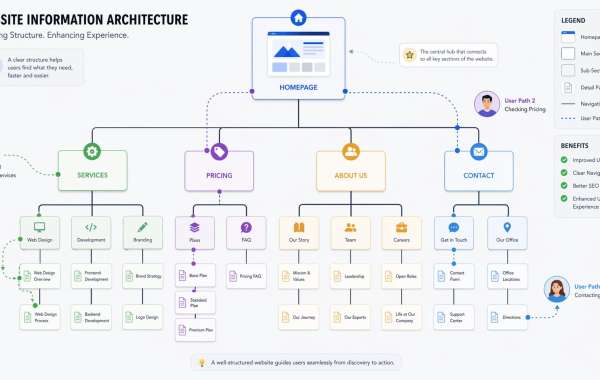
Your homepage is the smile that greets visitors at the door. They arrive, notice the colors, read the headline, and form an instant impression. That warm welcome matters. But what happens when they step inside? Do they find a well-organized space, or do they trip over clutter?
This hidden organizing force is information architecture. It is the system that arranges your content so people can locate what they need without conscious effort. A chaotic structure exhausts users. It chips away at the trust you are trying to build. No amount of front-page elegance can disguise a site that feels broken beneath the surface.
As a practicing web designer, I have witnessed countless projects underperform because teams obsessed over visual appeal while neglecting structural integrity. They contracted inexpensive web design services to stretch limited budgets, trusting that the site's internal logic would emerge organically. That trust evaporates the moment a visitor attempts to navigate past the landing page. Robust information architecture reinforces every section of your digital property, not merely the threshold where traffic first arrives.
Below is an examination of why your content's underlying framework demands attention, even without an imminent redesign on the horizon.
What Is Information Architecture?
Information architecture operates as the skeletal framework of your website. It determines how pages interconnect, how subject matter clusters into coherent groups, and how visitors traverse from one territory to another. Consider a botanical garden where plants are arranged by climate, growth habit, and bloom season. Contrast that with a field where specimens are scattered at random. One invites discovery; the other invites frustration.
Competent IA engineers transparent pathways. A visitor should recognize without deliberation which route leads to pricing details, which explains your capabilities, and which opens a channel to your team. Deficient IA strands them in uncertainty until they abandon the effort.
This responsibility extends considerably beyond the visible navigation menu. It encompasses directory trees, the mesh of internal hyperlinks, the intelligence of your search functionality, and the precision of every label and descriptor. Any mechanism that helps someone orient themselves and anticipate their options falls within this domain.
Why It Shows Up After the Homepage
The homepage is an overture, not the complete performance. Visitors arrive with specific objectives. They want to evaluate offerings, verify credentials, or obtain pricing. Obstruct their progress, and they will not linger to overcome your obstacles. Many organizations mistakenly assume the homepage shoulders the entire conversion burden. It does not. It sets the stage; the structure delivers the experience.
Envision a familiar scenario. A prospect encounters your value proposition and experiences a flicker of interest. They navigate to your Services section, anticipating substantive information. Instead, they confront a sparse overview containing several tangentially related subcategories. None clearly align with their particular need. They retreat to the search results and explore alternatives.
This behavioral pattern is epidemic across the digital landscape. Users sample briefly, then vanish. Your analytics narrate the story through metrics: shallow session depth, elevated departure rates, minimal dwell time. These indicators signal structural deficiencies, not superficial imperfections. Remediation typically demands reorganization rather than augmentation.
A proficient web designer who respects IA commences with flow diagrams, not color swatches. They model journeys around authentic user cognition and behavioral patterns before any visual design begins. That sequencing prevents the dissonance between visitor expectations and site delivery.
Common Problems to Watch For
Unclear Navigation Labels
Corporate vocabulary frequently contaminates menu systems. Terminology like Solutions, Frameworks, or Ecosystems supplants accessible language. An unfamiliar visitor lacks the contextual knowledge to decode these expressions. Prioritize clarity over corporate convention.
Too Many Options
A primary navigation menu distended with excessive alternatives immobilizes decision-making. The human cognitive capacity for simultaneous evaluation is limited. Constrain your top-level menu to a manageable quantity of entries. Relocate supplementary choices to secondary navigation elements.
Broken Links
Digital properties are dynamic organisms. Content evolves, URLs migrate, pages retire. Without vigilant maintenance, internal connections deteriorate into dead ends. Encountering a broken link resembles discovering a path that terminates abruptly. It conveys neglect. Instituting periodic integrity audits preserves navigational reliability.
Content Silos
Organizational boundaries frequently fragment the user experience. Departments maintain autonomous territories without coordination. Related information becomes marooned across disconnected sections. The antidote is collaborative planning that treats the website as an integrated ecosystem rather than departmental property.
Missing Hierarchy
Uniform visual treatment across all headings strips away navigational guidance. When every section header receives equal emphasis, readers cannot discern relative importance. A deliberate hierarchy of scale, weight, and spatial relationships channels attention productively.
How IA Affects Search Engines
Search engine crawlers navigate your digital property by traversing links, mirroring human behavior. A coherent, well-connected architecture enables them to comprehend interpage relationships and assess relative significance. That understanding directly influences ranking determinations.
Content isolated deep within your hierarchy—multiple clicks removed from the homepage—risks crawler invisibility. Valuable material may never be discovered or indexed. Recent publications languish in obscurity. Intelligent IA positions critical content within accessible reach and ensures appropriate distribution of link authority.
Indexing responsiveness is equally consequential. A cleanly structured site with an accurate sitemap permits search engines to detect and process modifications rapidly. When pricing changes or new offerings launch, that information surfaces in search results with minimal delay. In competitive environments, that velocity carries strategic advantage.
SEO and IA have merged into an integrated discipline. A web designer conversant with both dimensions constructs properties that satisfy algorithmic requirements while serving human needs.
Improving Your Current Site
Complete reconstruction is rarely obligatory. Surgical interventions frequently generate disproportionate returns.
Initiate with direct observation of authentic users. Assign representative tasks and document every hesitation, every redundant action, every abandoned trajectory. These behavioral signals pinpoint structural vulnerabilities with precision.
Consolidate fragmented content. Merge overlapping pages that address identical search intent. Eliminate superfluous navigational layers. Each incremental depth introduces friction that erodes engagement. Streamlining preserves momentum.
Implement breadcrumbs on interior pages. These unobtrusive navigational instruments reveal the user's precise coordinates within your site hierarchy and provide frictionless retreat pathways. They simultaneously reinforce structural signals for search engine crawlers.
Iterate menu configurations experimentally. Evaluate alternative groupings and sequences. Elevate high-priority destinations to prominent visibility. Peripheral information can reside in less conspicuous locations.
When to Hire Help
Scale eventually transcends internal capability. When page counts become extensive, engaging a professional web designer Singapore becomes strategically prudent. They introduce systematic methodologies and reusable frameworks. They establish conventions that sustain structural coherence amid content proliferation.
Digital commerce operations face particular sensitivity to architectural quality. Product catalogs spanning thousands of SKUs demand categorical logic that makes browsing intuitive. Shoppers unable to locate desired items efficiently will not complete transactions. Structural deficiencies translate directly into revenue erosion.
Established web design services embed strategic discovery within their foundational engagement model. They investigate business context, audience profiles, and competitive dynamics before generating visual concepts. That preparatory rigor prevents the costly iterations that follow superficial execution.
Do not defer attention to information architecture until performance metrics deteriorate. Act preventively. Modest interventions today avert systemic disruptions tomorrow.
Practical Tips for Building Better IA
Know Your Users: Anchor structural decisions in customer cognition. Organize according to audience mental models rather than internal departmental structures.
Map Before You Build: Develop schematic representations illustrating page interconnections. Validate navigational flows through wireframes prior to design execution.
Keep It Consistent: Maintain uniform terminology and placement throughout the property. Consistency cultivates predictability and reduces cognitive burden.
Test Early: Subject prototypes to usability evaluation during development. Identifying navigational obstacles in preliminary stages minimizes remediation expense.
Plan for Growth: Architect for anticipated expansion. Design capacity for emerging content categories and increased volume without necessitating periodic overhaul.
Audit Regularly: Review performance data on consistent intervals. Detect dead ends, elevated departure rates, and confusing traversal patterns. Respond to emerging patterns before they compound.
Final Thoughts
Your homepage captures initial attention. Information architecture determines whether that attention evolves into engagement and conversion. It guides visitors through your digital property until they achieve their objectives. Deprived of that guidance, even visually arresting sites become exercises in futility.
Respectful organization honors user intent and temporal investment. It proceeds from the recognition that visitors arrived seeking solutions, not obstacles. Whether you retain a web designer or direct improvements internally, assign structural planning equivalent priority with aesthetic considerations.
Clarity serves as the engine of conversion. Visitors who navigate effortlessly become customers who trust your brand implicitly. Engineer their journey to be direct, predictable, and rewarding.